Mark Gurman is reporting that Apple is reportedly working on touchscreen Macs. I stumbled upon this article over on Mastodon, when shared by MacStories founder and Editor-in-Chief, Federico Viticci. Alongside the article, he shared his concern about what a touch screen Mac could mean for the iPad line. I went ahead and responded to him with a few of my thoughts, but really wanted to expand on things just a bit here.
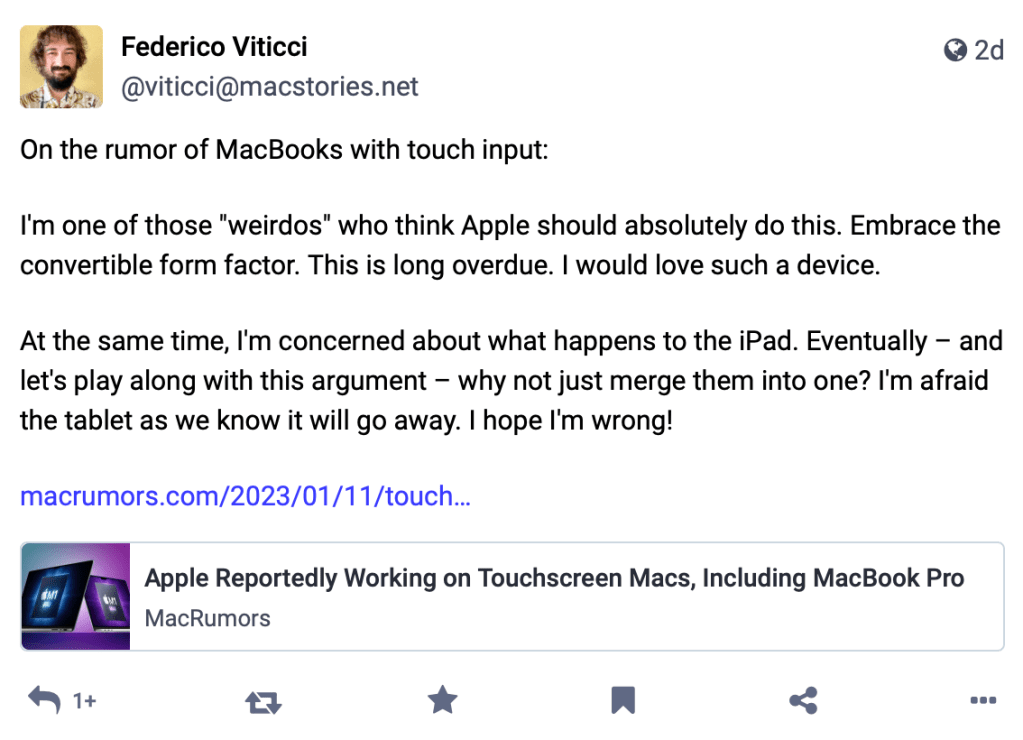
There’s a few factors here to consider when trying to figure out whether or not Apple would merge the two lines into one convertible line, if touch screen Macs were the future of Macs. The short answer is yes, I do think that Apple will potentially merge Macs and iPads down the road, but not all of them.
There’s a lot of factors at play here. The first is the cost of a Mac in the first place. I think I can be the first one to say that Macs aren’t cheap. The cheapest MacBook you can currently buy is the M1 MacBook Air that clocks in at $999. The cheapest iPad that Apple currently sells is the base model iPad (9th generation) for $329. That’s a fairly big gap in price. It’s one thing to upsell someone to the $449 iPad (10th generation), but for most basic of needs, having the base device cost at least a thousand dollars is unrealistic.
Likewise, MacBooks aren’t “small” devices. Sure the screen on a 13″ MacBook Pro (the device I’m currently writing this on) is small compatibly speaking, it’s still a heck of a lot larger than an iPad mini. If someone’s in the market for a small tablet that takes up the least amount of space, there’s no way to make that device a full-fledged MacBook as well, without some serious compromises one way or another.
The same goes for schools. iPads in education are a thing, but when it comes to schools, they’re generally buying cheaper devices. When it came to giving every student a laptop during the pandemic, you saw Chromebooks everywhere. There’s a reason those students weren’t given MacBooks.
Realistically, no matter what Apple decides to do, I think the base model iPad, iPad mini, and (most likely) iPad Air will all be safe. That would be too big of a business hit for Apple to take.
That brings us to the higher end of the iPad line: the iPad Pro. This is the device that I am not confident would come out of the transition to touch screen, convertible Macs unscathed and for good reason. When it comes to the iPad Pro, there’s a very vocal group of users (all content creators that I respect), begging Apple for more power for their tablet. Once Apple added the M1 chip to the iPad Pro, those requests skyrocketed even more.
Making touch screen Macs, specifically a MacBook Pro, that can convert into a tablet form factor (either by folding backwards or detaching), would be a way to give those hoping for more power in their iPad just that.
Ever since Apple switched to their own silicon, I’ve seen them making some really interesting designs for their machines that seemed to me to be ways to test how little cooling Apple silicon can get by with while still delivering the most power.
Sometimes my iPad Pro gets a little hot when playing a graphics intensive game. As for my MacBook Pro, I don’t put it through anything that demanding, but I can’t recall ever hearing the fans kick on in this thing. I almost want to open it up to make sure the fans are in there.
The point is, Apple’s own silicon is fairly powerful and could be just the thing they need to take the MacBook line to the next level, while simultaneously eliminating the need for the highest end iPad. The lower hardware will stay safe because of the lack of overlap in use cases and the need for a basic tablet for that aren’t interested in having access to devices that cover higher end needs.
It’s also worth keeping in mind that these are just rumors up to this point. Regardless, it’s still a lot of fun to speculate about what the future of the Mac and iPad lines could look like.

 Dan Stransky