Dan’s Note: I originally wrote this post the week of Dub Dub, but due to some back issues I’ve been experiencing, I haven’t had a lot of time to work on things for the blog. This post sat in my drafts long enough, so It’s finally time for it to see the light of day.
If there was one part of the WWDC keynote that really stood out as strange to me, it was the portion dedicated to gaming. During that time, Apple unveiled their Metal 3 graphics API, which I’ll let them explain with this excerpt from their press release:
Metal 3 — the latest version of Apple’s graphics framework — comes with new features that enable game developers to tap into the power of Apple silicon for even greater gaming performance. MetalFX Upscaling enables developers to quickly render complex scenes by using less compute-intensive frames, and then apply high-quality spatial upscaling and temporal anti-aliasing. The result is accelerated performance that makes games feel more responsive and graphics that look stunning. Game developers also benefit from a new Fast Resource Loading API that minimizes wait time by providing a more direct path from storage to the GPU, so games can easily access high-quality textures and geometry needed to create expansive worlds for realistic and immersive gameplay.
Now there’s a few things to take away from this. The first, based on the line “…to tap into the power of Apple silicon…” makes it fairly clear that Metal 3 won’t be supported on non-M1 based hardware. That’s particularly interesting because in addition to releasing No Man’s Sky and Resident Evil Village for the Mac, at least the former is coming to iPad as well. Based on the wording in the press release, it’s safe to say that No Man’s Sky will only be supported on iPads running Apple silicon (though because the game can run on the Switch, anything is possible). This wouldn’t be the first time that a game on the App Store was restricted to only certain models of a product, but to restrict it to only M1 iPads would be weird.
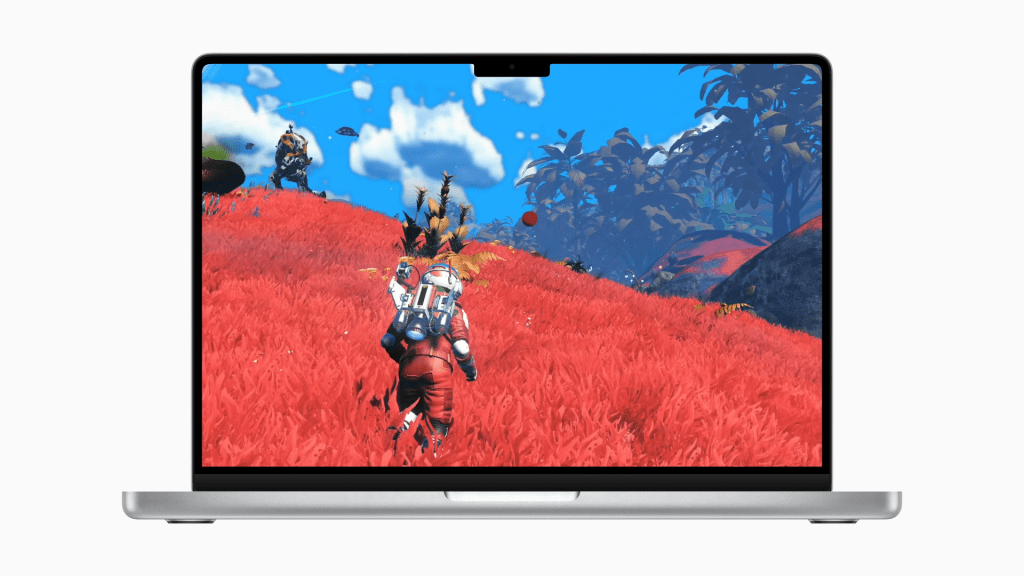
On the one hand, there’s no denying that Apple silicon is powerful. But we’re also not so far removed from the transition from Intel that the Developer Transition Kit (or DTK for short) is completely forgotten either. For those that have forgotten, though, the DTK for Apple Silicon was running an A12Z chip. For point of reference, the 2020 iPad Pro that I own has an A12Z Bionic inside of it. If the A12Z was good enough get Apple silicon off the ground, I’m amazed that the company doesn’t let it keep at lease some feature parity with a true M1 chip.
But here’s the second, and potentially bigger, take away: if the M1 chip can get something like No Man’s Sky running on the Mac, maybe it’s time for an M1 Apple TV.
I’ve been very vocal in the past that with Apple Arcade, it’s time for Apple to release an Apple TV focused on gaming. When they didn’t do it after I first suggested it, I wasn’t all that surprised as it was mostly wishful thinking. But now, with Apple screaming from the rooftops how powerful this chip is and the experiences it will bring to the Mac for gamers…well now I really want to know why Apple isn’t embracing the Apple TV as the gaming machine it can be.
The biggest reason that I love my Nintendo Switch is that I can pull it out during my lunch break and play a game on it, putting it in the dock when I get home to play the same game on the TV. If Apple is going to bring a game like No Man’s Sky to iPad, they could absolutely give gamers a Nintendo Switch-like experience, only with two devices instead of one. Apple Arcade already offers this to an extent, but you’ll be hard pressed to find many games that come close AAA quality on the service. Still, that could be where Apple is ultimately going.
In an article posted earlier, I posited that Apple could be planning to release an M-based iPhone in the future. As I was researching and writing this article, that thought crept back into my mind. There’s definitely a battery hurdle that Apple would need to cross, but what if they really are trying to shove Apple silicon into an iPhone one day — that could be the ultimate Switch-like experience.
Using No Mans’s Sky as the example, just think about it. You could get up in the morning and play a bit of the game on your iPhone during the commute. If you have some downtime around lunch you could play it on your iPad. Finally, when you get home for the night, you could settle in for a long, post-dinner gaming sessions to play on your Apple TV. Just like that Apple goes from having a weirdly fragmented experience to having a hell of a marketing opportunity.
Whether that’s the route they go remains to be seen, but the more I look at what Apple is doing, the more I think the endgame is Apple silicon everything.

 Dan Stransky